Thierry Gustin's GEO method: measure, then grow your citations in AI answers
The GEO method I use starts by measuring, on a panel of real questions asked several times to several AI engines, whether a brand is cited, how it is described and which sources are cited instead. It then fixes, in this order, the technical foundation, the content, the entity and the presence on third-party sources, and measures again every month on the same panel. This document sets out its steps, its indicators and how they are calculated, the measurement protocol and its limits.
Version 1.0, published November 20, 2026. Author: Thierry Gustin, GEO and SEO consultant based in Madrid, working in search since 2011. This is the method behind my GEO audits and my AI search optimization engagements. It relies on two open-source tools I wrote, Arachnide SEO Spider and Vigie, whose code is public.
What principles is the method based on?
- Measure before acting. No recommendation without a baseline: you can only fix well what you have measured, and you can only prove progress by comparing two measurements made the same way.
- Think in frequencies, never in screenshots. AI answers vary from one run to the next. Every question is therefore asked several times, and the indicators are rates calculated across all answers.
- GEO is built on SEO. A page that crawlers cannot read or index will not be cited. Google says so itself: there is no special optimization for its AI features, and SEO best practices remain the foundation (see the GEO guide).
- Several engines, measured separately. ChatGPT, Claude, Gemini, Perplexity and Google do not search or cite the same way. An overall figure hides gaps that have to be seen engine by engine.
- Evidence, not tricks. The levers used are the ones documented by research and by the engines themselves: accessible content, a clear answer, sourced figures, a consistent entity, confirmation by third-party sources.
- No manipulation. No fake reviews, no paid mentions, no pages built to deceive the engines. Since May 15, 2026, Google's spam policies cover attempts to manipulate generative AI answers.
- Transparency. The panel, the raw answers and the calculations are handed over to the client. The measurement tools are open source: anyone can check how a figure was obtained.
What are the steps of the GEO method?
The method has seven steps. The first three make up the audit; steps 4 to 6 are the implementation; step 7 closes the loop and restarts the cycle every month.
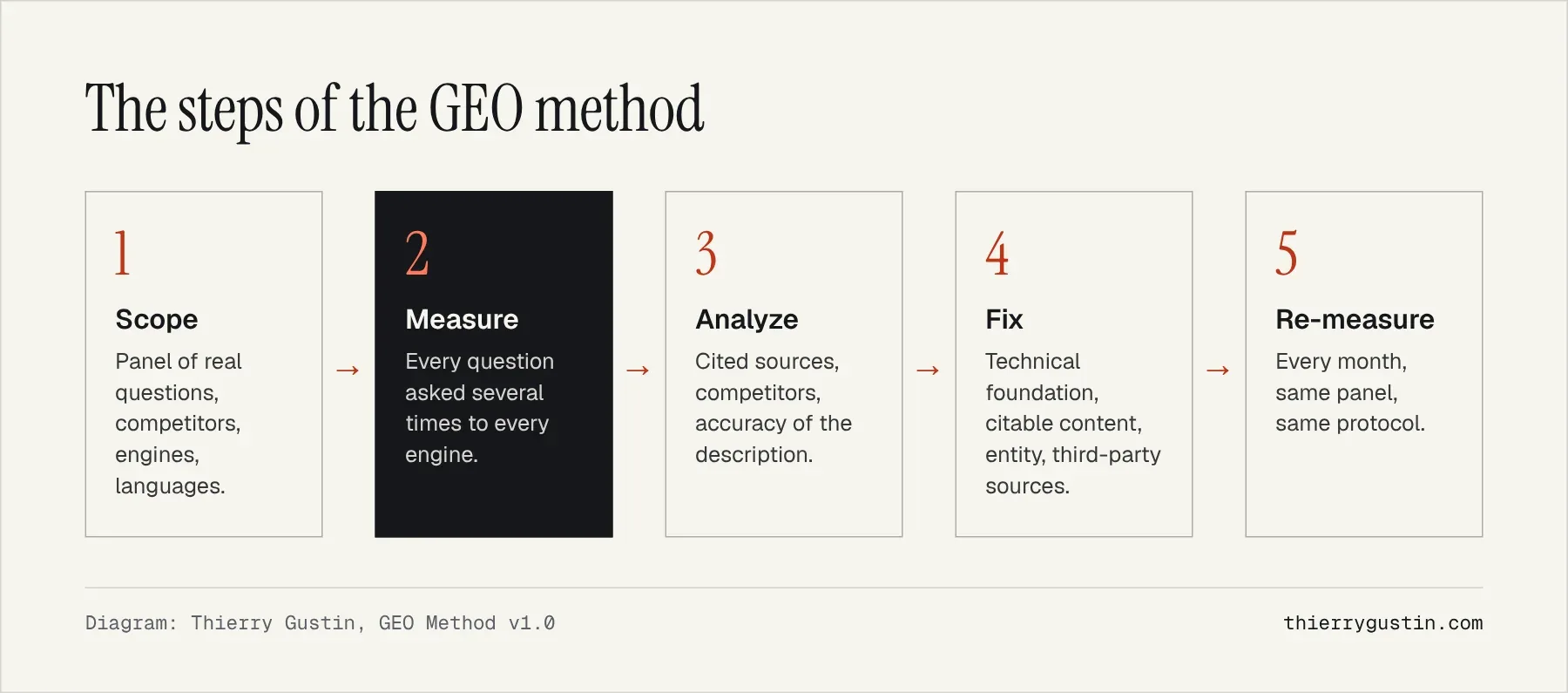
Step 1: scope the panel of real questions
The panel brings together 30 to 100 questions your customers actually ask before buying, chosen together during a 30-minute scoping call. They come from your sales conversations, your customer service, your Search Console queries and the questions your customers say they ask an AI.
- Choice questions: “which provider for… in Lyon?”, “best software for… for a small business”.
- Comparison questions: “your brand or a given competitor?”.
- Price and terms questions: “how much does… cost?”.
- Definition or method questions, where an expert page can be cited.
- Questions about the brand itself: “what does this company do?”, to check what AI engines say about it.
We also set the list of tracked competitors (usually 3 to 8), the languages (French, Spanish, English) and the countries. The panel is then frozen: changing the questions midway would make the measurements impossible to compare. If it needs to grow, we start a new series and note it in the report.
Step 2: measure on several engines, repeatedly
Every question is asked to every engine several times, in separate sessions, and every complete answer is archived with its sources. For ChatGPT, Claude, Gemini and Perplexity, measurement runs through Vigie, which queries these engines through their APIs with web search turned on. Google's AI Overviews and AI Mode are recorded on the same questions when they appear. Since Microsoft Copilot relies on the Bing index, tracking also goes through Bing Webmaster Tools.
The volume is easy to work out: number of questions × number of engines × number of repetitions. A panel of 40 questions measured on 4 engines with 3 repetitions gives 480 answers per measurement and per language. All indicators are calculated on these answers.
Step 3: analyze cited sources and competitors
For each question, we list the brands named and the domains cited as sources. Three lessons come out of this: who is cited instead of you, which types of sites the engines draw on (brand sites, media, comparison sites, directories, forums, reviews) and which specific pages serve as sources. These third-party pages become targets: being mentioned there, accurately, is often more effective than publishing one more page on your own site.
We also check the accuracy of what AI engines say about you: business, location, offer, prices, contact details. A wrong or outdated description is an entity problem to fix first, because it repeats from one answer to the next.
Step 4: strengthen the technical foundation
The whole site is crawled with Arachnide SEO Spider. The checks are those described in the GEO guide:
- Server-side rendering: the main content must be in the HTML sent by the server, because the main AI crawlers do not execute JavaScript (details). Arachnide compares raw and rendered HTML, page by page.
- Crawler access: robots.txt, firewall and CDN checked for Googlebot, Bingbot, OAI-SearchBot, Claude-SearchBot and PerplexityBot. Blocking training crawlers remains a valid choice, to be kept separate from search crawlers (details).
- Indexing: Search Console and Bing Webmaster Tools, up-to-date sitemap, 404 errors and redirects fixed.
- Structured data: Organization, Person, Service, Product, Article, consistent with the visible text, never the other way around (details).
- llms.txt and Markdown versions: optional. They cost little, but Google states it does not need them for its AI features. I treat them as a bonus, never as a priority (details).
- Speed: server response time and page weight, measured before and after the fixes.
Step 5: make the content citable
Every priority question in the panel must have a page, or a section, on your site that answers it. The page answers in its first two or three sentences, then goes into detail. It brings dated, sourced evidence, names its author, shows its last-updated date and contains information that cannot be found elsewhere: your prices, your lead times, your experience. Existing pages are rewritten before new ones are created.
This choice rests on the research paper that coined the term GEO (Aggarwal et al., KDD 2024): adding statistics, quotations and sources ranks among the most effective methods, while keyword stuffing performs worse than the original text.
Step 6: clarify the entity and earn third-party sources
AI engines more readily repeat information that several sources confirm. So we align the name, the business, the service area and the contact details across the site, the Google Business Profile, LinkedIn, directories and professional profiles. We then work on presence in the third-party sources identified in step 3: industry media, comparison sites, reference directories, customer reviews on independent platforms. Only through genuine means: press relations, expert contributions, review requests to real customers.
Step 7: measure again every month
Every month, the same panel is measured again with the same protocol. The report compares the indicators with the previous month and with the baseline, engine by engine, then sets the priorities for the following month. These figures are cross-checked with the generative AI features report in Search Console, the AI Performance report in Bing Webmaster Tools and the traffic coming from AI assistants in your analytics.
Which indicators does the method measure, and how are they calculated?
Five main indicators, calculated per engine, per language and for the whole panel. They are not interchangeable: a brand can be named often without its site ever being cited as a source, and vice versa.
| Indicator | Definition | Calculation |
|---|---|---|
| Brand mention rate | Share of answers that name your brand, another name of your company or your site | Answers naming you ÷ answers obtained × 100 |
| Citation rate | Share of answers that cite a page of your site among their sources | Answers citing your site ÷ answers that show sources × 100 |
| Share of voice | Your presence compared with that of the tracked competitors, on the same panel | Your mentions ÷ mentions of all tracked brands (including you) × 100 |
| Description accuracy | Share of answers that describe you correctly (business, location, offer, prices, contact details) | Accurate answers ÷ answers that mention you × 100, on an accurate / partial / wrong scale |
| Competing sources | Domains cited instead of you across the panel | Domains ranked by the number of answers in which they are cited, with their type (brand, media, comparison site, directory, forum) |
Two indicators complete the picture. Average position shows at what rank your brand appears among the tracked brands named in an answer (1 = first). Vigie's visibility score, from 0 to 100, combines presence, position and site citation; it is meant to follow a trend, not to compare industries with each other.
Worked example: if, out of 480 answers, 120 name your brand, your mention rate is 25%. If 300 of those 480 answers show sources and 45 cite your site, your citation rate is 15%. These numbers illustrate the calculation; they are not a client result.
What is the measurement protocol?
| Parameter | Rule |
|---|---|
| Panel | 30 to 100 real questions, frozen for the whole tracking period |
| Engines | ChatGPT, Claude, Gemini and Perplexity through their APIs with web search (Vigie); Google's AI Overviews and AI Mode when they appear; Bing index for Copilot |
| Repetitions | 3 per question and per engine at each measurement, in separate sessions |
| Frequency | Baseline measurement during the audit, then one measurement per month; weekly is possible during a period of changes |
| Languages and countries | One measurement series per language (French, Spanish, English) and per target country |
| Archiving | Complete answers, sources and date kept; CSV and JSON exports handed over to the client |
| Additional data | Search Console (generative AI features), Bing Webmaster Tools (AI Performance), AI assistant traffic in your analytics |
One important caveat: answers obtained through the API, with web search turned on, may differ from what a user sees in the app, which takes their history, location or subscription into account. The method therefore measures a trend that is comparable from one month to the next, not the exact screen of every customer.
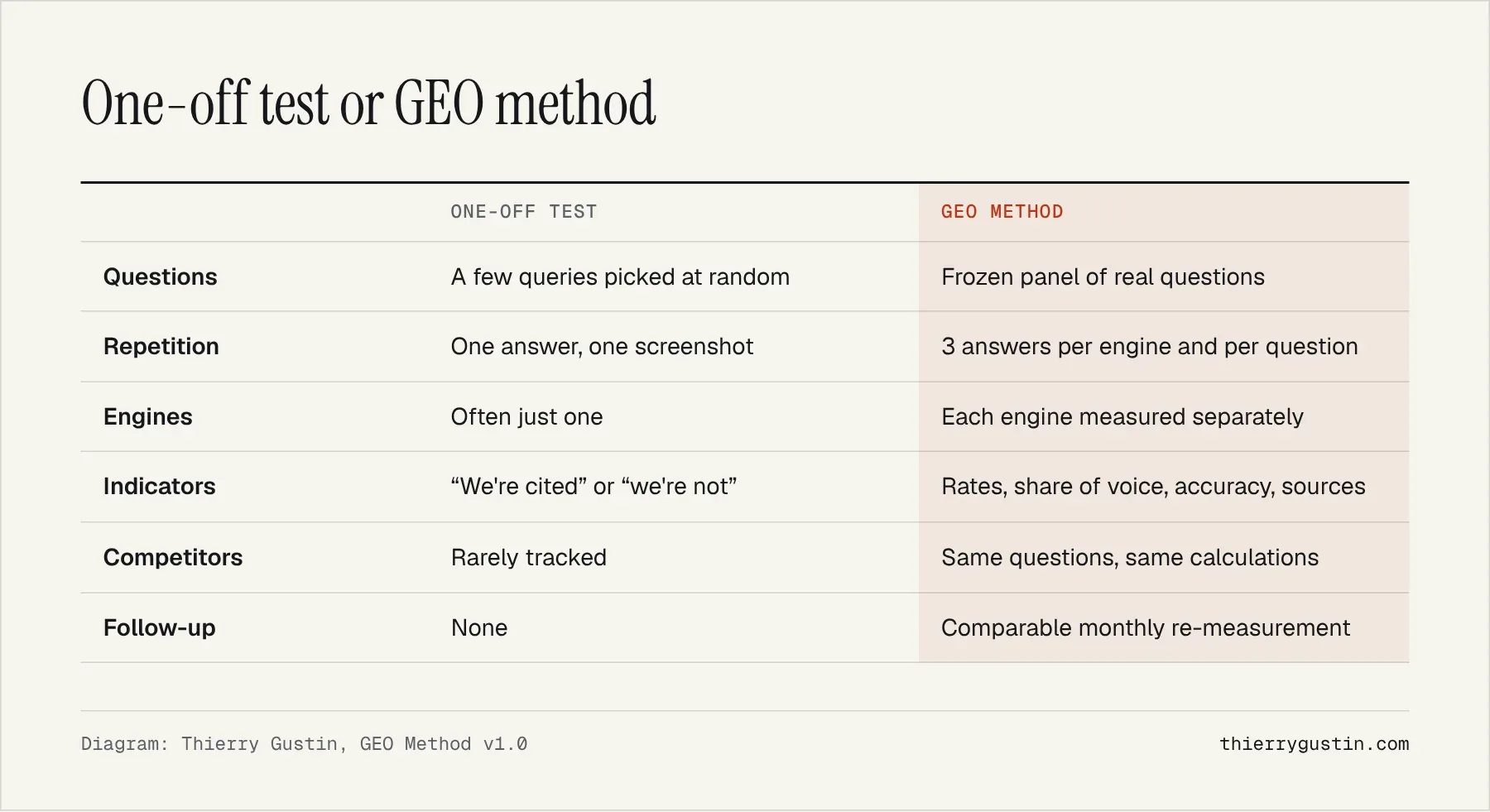
How does the method differ from a one-off test?
What does the method not promise?
- No guaranteed citation. AI engines choose their sources on their own; nobody can promise to be cited for a given question.
- No figures promised in advance. I promise no citation rate, no traffic and no precise timeline. Engines that search in real time can pick up a fixed page within a few weeks; the models' internal knowledge changes at the pace of their updates, so more slowly.
- Not every user's screen. Answers are personalized and vary: the method measures frequencies and trends, not an absolute truth.
- No proven causality, action by action. When a rate goes up after a fix, it is a signal, not proof: engines, competitors and models change at the same time.
- No paid citations. Citations in answers cannot be bought. Ad formats in assistants are separate from the answers and are not part of this method.
- No client results published without proof. I only publish verifiable results, with the client's written consent.
Which open-source tools does the method use?
Arachnide SEO Spider
Open-source SEO crawler (MIT license): optional JavaScript rendering and raw / rendered HTML comparison, AI crawler access, llms.txt detection, log analysis, Search Console and GA4. Overview.
Vigie
Open-source AI visibility tracker (MIT license) that runs on your own computer, with your own API keys: mention rate, share of voice, position, site citation rate and cited sites. Overview.
Search engine tools
Google Search Console, Bing Webmaster Tools and its AI Performance reports, PageSpeed Insights: free, first-hand data.
The code of both tools is public on GitHub: anyone can reproduce a measurement, check a formula or report an error. This is also what makes an audit's figures verifiable by the client themselves.
How do you apply this method to your site?
- For a free first assessment, take the GEO check: 10 questions, 2 minutes.
- For the full measurement (steps 1 to 3) and a prioritized action plan, request a GEO audit, from €900 excl. VAT for a single-language brochure site.
- For implementation and monthly re-measurement (steps 4 to 7), see the AI search optimization engagement, from €2,400 excl. VAT per month.
- To apply it yourself, both tools are free and the GEO guide covers each lever in detail.
Version history
| Version | Date | Changes |
|---|---|---|
| 1.0 | November 2026 | First published version: seven steps, five main indicators, measurement protocol |
The figures this method builds on (AI assistant adoption, clicks, cited sources) are gathered and sourced on the GEO and AI statistics 2026 page.
Frequently asked questions about the GEO method
Why ask each question several times?
Because AI engine answers vary from one run to the next, even for the same question. A single answer can show you as cited or absent by chance. By asking each question three times to each engine, you get more stable rates and can honestly compare two monthly measurements made with the same protocol.
What is the difference between mention rate and citation rate?
The mention rate counts the answers that name your brand. The citation rate counts the answers that cite a page of your site among their sources. An AI can talk about you while relying only on other sites: you are then mentioned without being cited, which is useful information when deciding what to fix.
How many questions should the panel include?
Between 30 and 100, depending on the size of the offer and the number of languages. Below 30, the rates swing too much from one measurement to the next; above 100, query costs and analysis time go up without changing the priorities. The panel is chosen with you during the scoping call, based on real customer questions.
Does the method work for a small local business?
Yes. The panel is simply shorter and focused on local questions (“which provider in…”). For these questions, entity consistency, the Google Business Profile, directories and reviews carry a lot of weight, and these are levers a small business can work on.
Can I reuse or cite this method?
Yes, with attribution: Thierry Gustin, GEO Method, version 1.0, November 2026, https://thierrygustin.com/en/geo-method. The tools it uses, Arachnide and Vigie, are MIT-licensed and reusable, including for commercial use.
Apply the GEO method to your site
A 30-minute scoping call is enough to define your question panel, your competitors and your priority engines, and to give you a fixed quote.