Google’s November 2026 Core Update: What to Do, and What Not to Do, Before It Ends
 By Thierry Gustin
Updated
6 min read
Contents
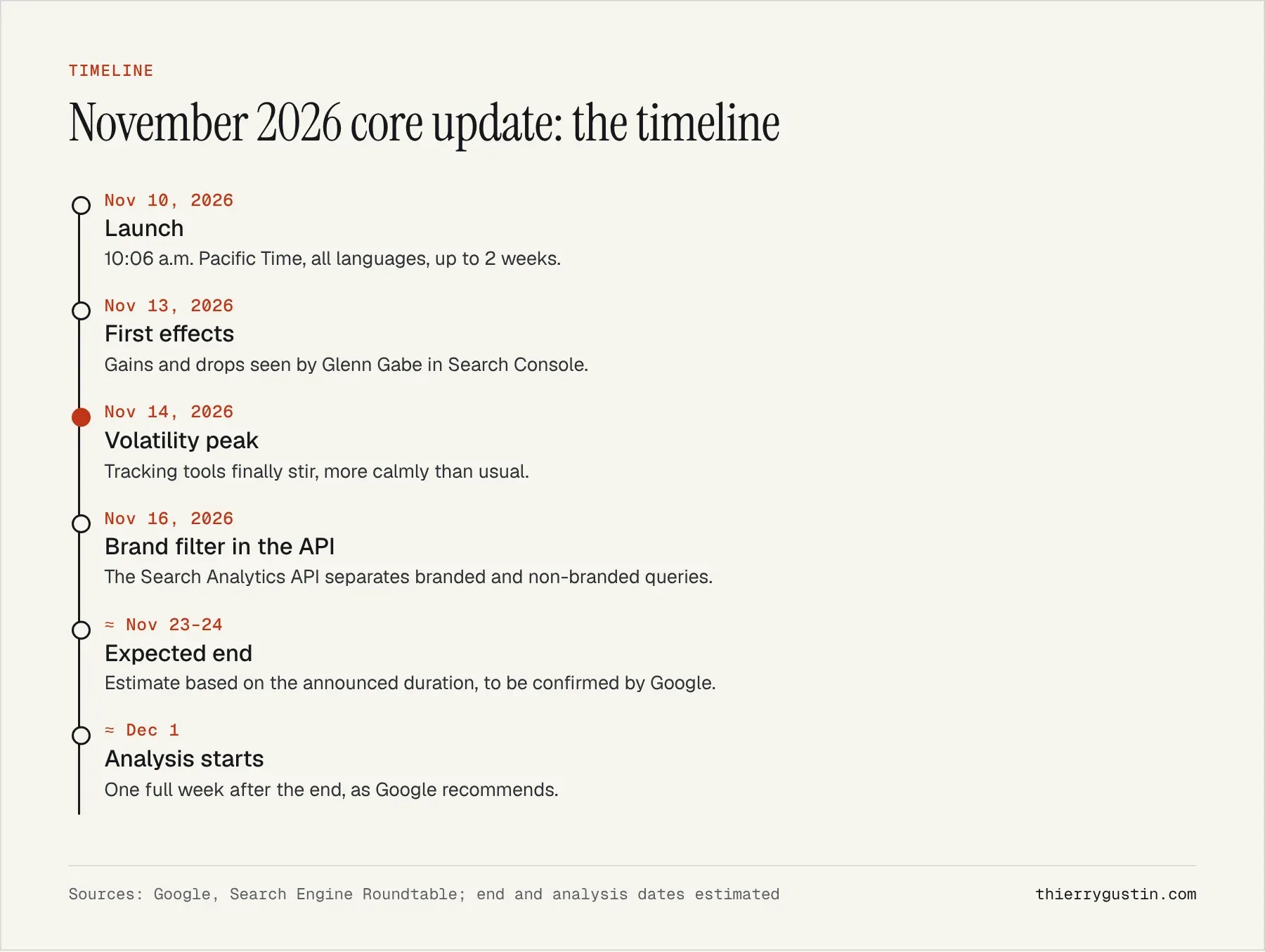
November 2026 core update: as of November 19, the short answer is to change nothing on your site until the rollout is complete. Google launched this core update on November 10, 2026 at 10:06 a.m. Pacific Time, for all languages and all countries, with a rollout that “may take up to 2 weeks”[1]. The end is therefore expected around November 23 or 24, and serious analysis will only begin a week later.
For a small business, a core update is the moment when the temptation to do the wrong thing is greatest: rewriting pages that worked, deleting content, changing agencies on the strength of three days of charts. This one adds a difficulty: the volatility arrived late, and tracking tools are struggling to measure it[4]. Here is what we know, and the approach I recommend to my clients during these two weeks.
What do we know about the November 2026 core update?
Google described it as “a regular update designed to better surface relevant, satisfying content for searchers from all types of sites,” in other words a routine update with no announced target[3]. The Google Search Status Dashboard dates it to November 10 and does not yet give it an end date[2].
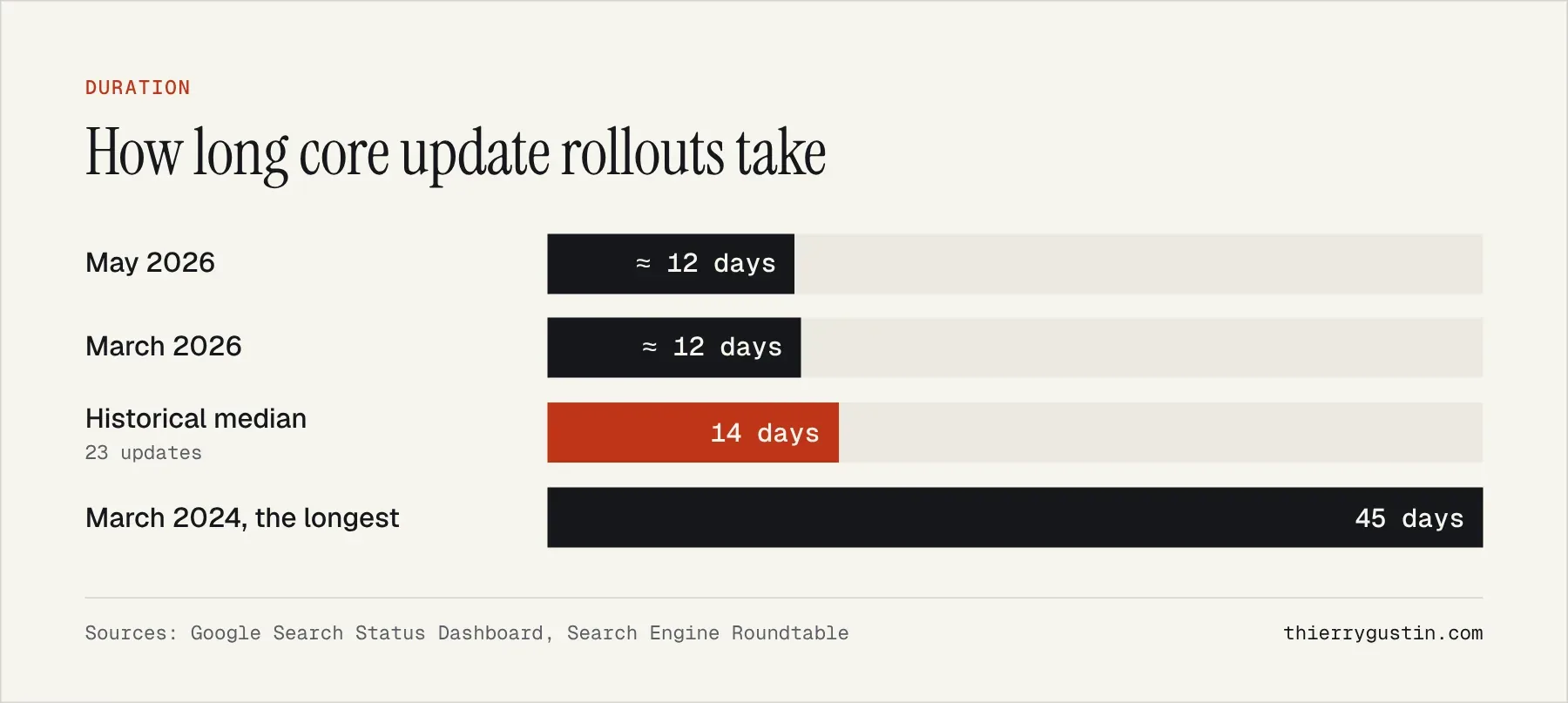
It is the third core update of 2026. The March update ran from March 27 to April 8, the May update from May 21 to June 2, each in just under twelve days[2]. Search Engine Roundtable calculates a median duration of 14 days across 23 core updates, the longest being March 2024, at 45 days[3]. Two weeks is therefore the reasonable assumption, with no guarantee. In practice, plan for the end of November and keep some slack in your schedule.
Why did the volatility arrive late?
In the first few days, almost nothing moved in the tools. According to Barry Schwartz, the peak in volatility and chatter came on Saturday, November 14, and Glenn Gabe believes the update really landed on Friday the 13th[4]. Movements remained calmer than usual, which Barry Schwartz partly attributes to third-party tools having trouble collecting data.
Glenn Gabe goes further in his November 17 observations, reported by Search Engine Roundtable: visibility tools are not reliable right now, because of filtering and “poisoned” results, and he treats Search Console as the only source of truth[4]. He sees gains and drops from the 13th onward, in both directions, and sharp declines for domains that had scaled up AI-generated content. He also flags sites hit earlier in November by “phantom clicks” from agents, which muddy comparisons.
Another source of noise: Google is testing interface changes at the same time. On November 13, Glenn Gabe spotted a test in which the AI Mode tab disappears from the search bar and the “Ask anything” box is missing below an AI Overview; Google has confirmed nothing[6]. When the results page changes shape, clicks change too, without rankings being the cause.
What does Google recommend during and after a core update?
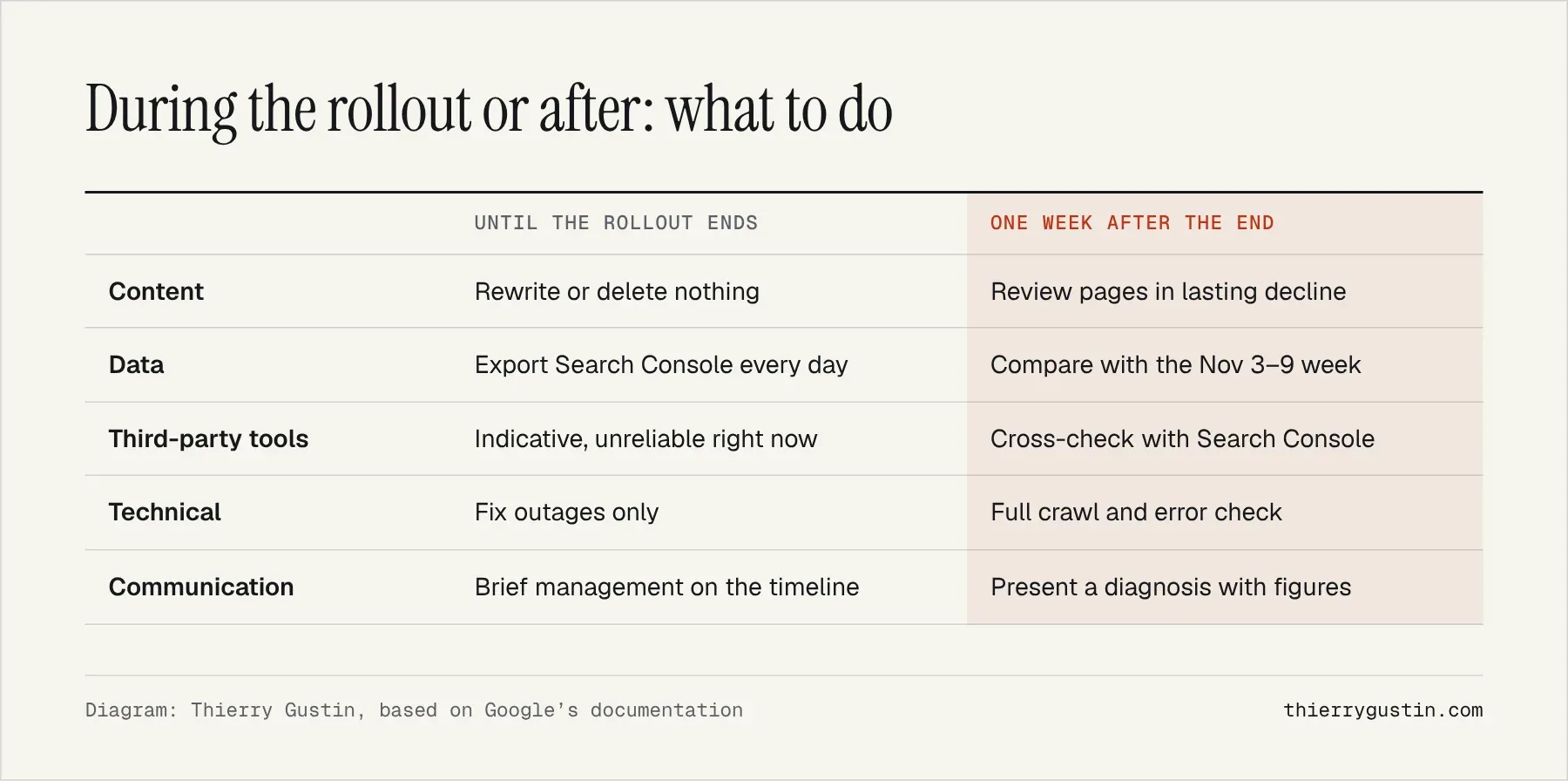
Google’s documentation is clear on timing[5]. You should check on the dashboard that the rollout has finished, then wait at least one full week before analyzing your site in Search Console. The comparison is made between the week after the end and a week before the launch. In other words, patience is part of the method here, not a sign of inaction.
On substance, Google advises against touching content that performs well and against looking for quick fixes. A slight drop in position does not justify radical action; a large, lasting drop calls for an overall review of the site’s helpfulness and reliability. Deleting content should remain a last resort. And if improvements are made, Google warns it can take several months for them to be reflected, sometimes until the next core update[5].
My take
My analysis: this core update comes at a time when isolating its effect is harder than ever. AI Overviews appear on a large majority of searches, Google is testing the AI Mode interface, and third-party tools have poor visibility. A drop in clicks in November may come from the update, from a layout change, or from both at once.
For an online store, the calendar adds to this: Black Friday falls on November 27, right after the likely end of the rollout. The week that follows will not be comparable to a normal early-November week. So I advise my e-commerce clients to also compare with the same period in 2025 and to look at positions, not just clicks.
The one reaction from Glenn Gabe I would adopt as is: Search Console as the source of truth. Visibility curves from the tools remain useful for spotting a market trend, not for judging your site day by day.
What should you actually do before the rollout ends?
- Export your data now: pages, queries, clicks, impressions and positions from Search Console, from November 3 to today, to keep a day-by-day record.
- Separate branded and non-branded: since November 16, the Search Analytics API also allows this split, already available in the interface for eligible properties[7]. A drop on your name does not have the same cause as a drop on generic queries.
- Log every change on your side: launches, migrations, campaigns, seasonality. Without this log, the December analysis will be impossible.
- Rewrite nothing and delete nothing until at least one week after the end announced by Google.
- Prepare the analysis: baseline week November 3 to 9, comparison week to be set as soon as Google dates the end.
If the drop is confirmed in December, the method I described for reading your numbers after the March core update applies as is, and the article on the May core update shows how to separate two overlapping effects.
Frequently asked questions
When does the November 2026 core update end?
Google launched it on November 10, 2026 at 10:06 a.m. Pacific Time and says the rollout may take up to two weeks. The end is therefore expected around November 23 or 24, but only the update to the Google Search Status Dashboard will be authoritative. The March and May 2026 core updates each took just under twelve days.
Should you change your site during a core update?
No, except to fix an outage. Google recommends waiting until the rollout ends, then at least one full week before analyzing the data. Rewriting or deleting pages along the way makes it impossible to know what caused the change, and Google advises against quick fixes such as deleting content, which should be a last resort.
Why does my rank tracker show almost nothing?
In November 2026, several observers report that third-party tools are having trouble collecting data, with filtered or distorted results. Volatility only appeared on November 14, four days after the launch. Glenn Gabe recommends treating Search Console as the source of truth, because it reflects your site’s real traffic.
How can you tell if a drop comes from the core update or from AI Overviews?
Look at positions as well as clicks. If average position holds and clicks fall, the cause is more likely the results page, for example an AI Overview. If positions drop clearly from November 13 or 14, the core update is the main suspect. Separating branded and non-branded queries also helps settle the question.
Sources
- Google Search Status Dashboard, November 2026 core update (November 10, 2026)
- Google Search Status Dashboard, ranking update history (accessed November 19, 2026)
- Search Engine Roundtable, Barry Schwartz, launch of the November 2026 core update (November 10, 2026)
- Search Engine Roundtable, Barry Schwartz, “Google November 2026 Core Update Ranking Flux - What We’re Seeing” (November 16, 2026, updated on the 17th)
- Google Search Central, core updates and what site owners should know
- Search Engine Roundtable, Google tests removing the AI Mode tab and the “Ask anything” box (November 13, 2026)
- Search Engine Roundtable, the Search Analytics API adds branded queries and new filters (November 16, 2026)
Read next
AI Mode and AI Overviews Don’t Cite the Same Sources: Measure Them Separately
AI Mode vs AI Overviews: only 13.7% of cited URLs in common, per Ahrefs. What the study says, what has changed since, and how to measure both.