AI Mode and AI Overviews Don’t Cite the Same Sources: Measure Them Separately
 By Thierry Gustin
6 min read
Contents
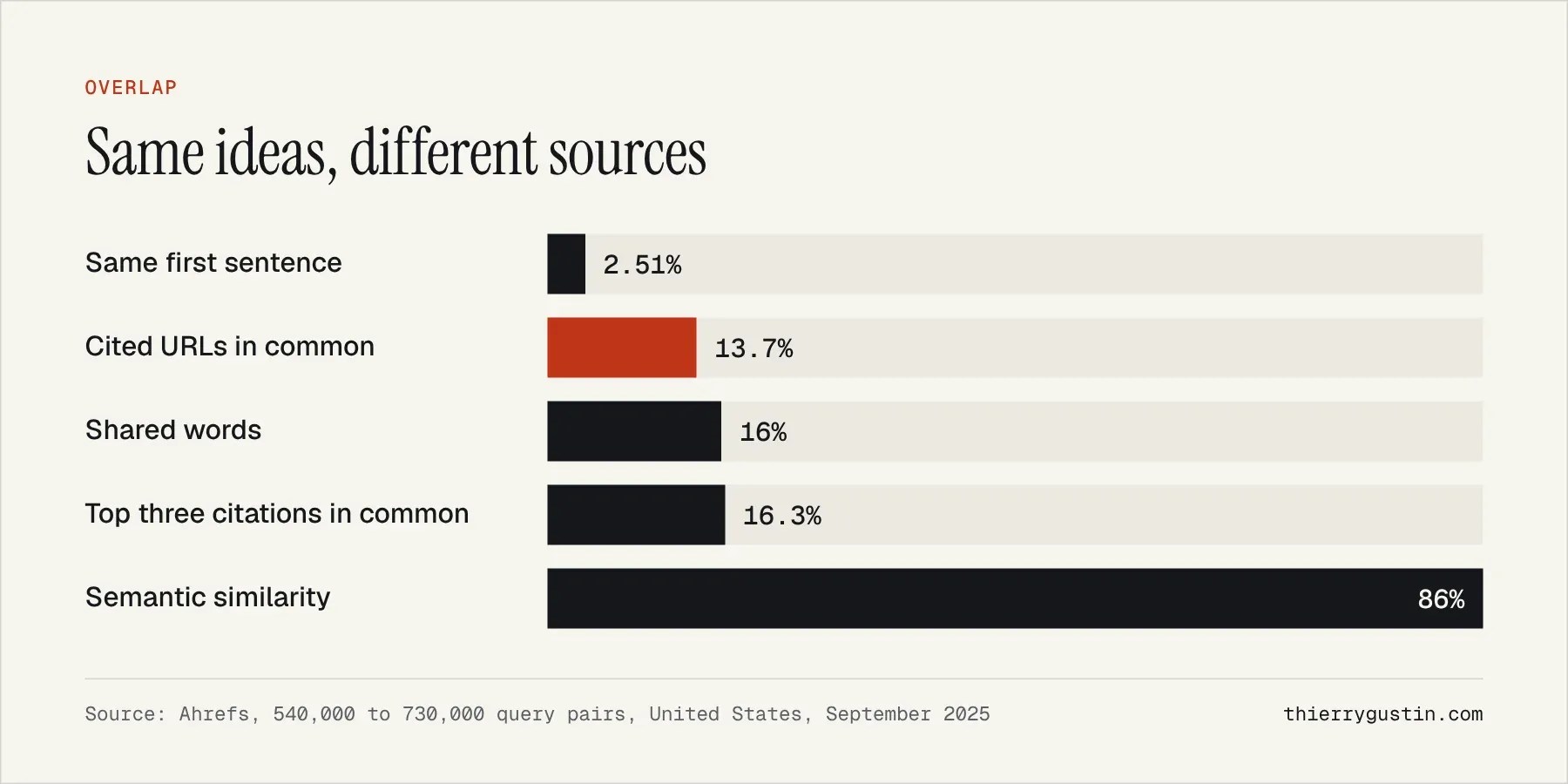
AI Mode vs AI Overviews: Google’s two AI surfaces almost never cite the same pages. For the same query, Ahrefs found only 13.7% of cited URLs in common, even though the two answers say the same thing in 86% of cases[1]. Being cited in one therefore tells you nothing about your presence in the other. You need to measure both surfaces separately, and adapt your content to each.
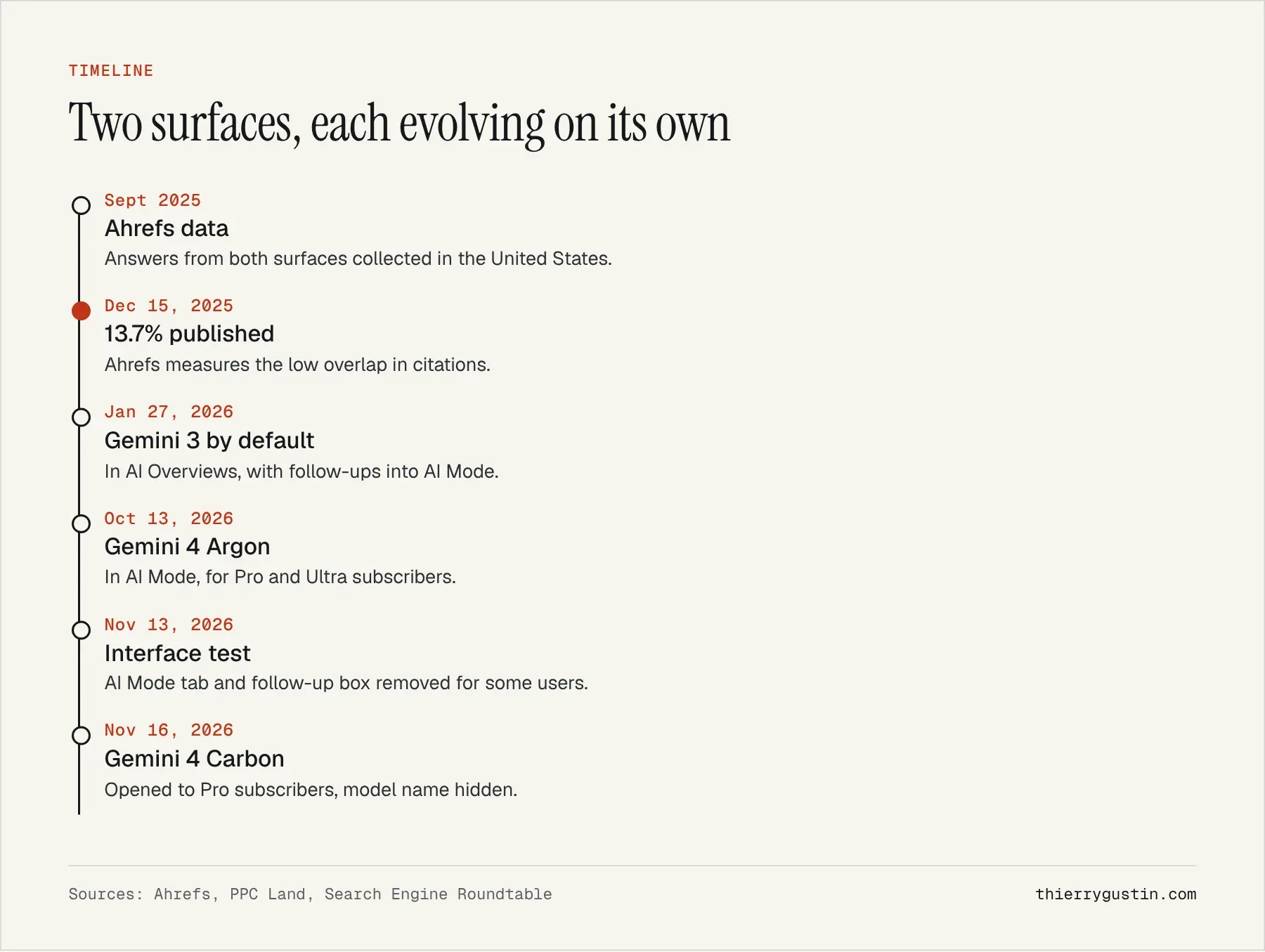
The figure is circulating again in GEO news roundups in November 2026, often without a date. I checked it at the source: it comes from an Ahrefs study published on December 15, 2025, based on US data from September 2025[1]. So it is a year old. But since then, the two surfaces have drifted further apart, if anything: they no longer run on the same models, and Google keeps changing how users move from one to the other. That is what makes it useful today.
What exactly does the Ahrefs study say?
Despina Gavoyannis and the Ahrefs team compared answers from the two surfaces using Brand Radar data, in the United States, in September 2025[1]. The citation analysis covers 540,000 query pairs, the content analysis 730,000. The result: 13.7% of cited URLs in common, and 16.3% if you only look at the top three citations.
The texts, for their part, are similar in substance but not in form. Semantic similarity averages 86%, but only 16% of the words are shared, the first sentence is identical in just 2.51% of cases, and strictly identical answers account for only 0.51%[1]. In other words, Google reaches the same conclusion by two different paths, with two different sets of sources.
Ahrefs itself points out a limitation: each answer is a snapshot, and an earlier study had shown that about 45% of an AI Overview’s citations change from one generation to the next[1]. The two pools of sources may overlap a little more than this figure suggests, but not to the point of making them a single surface.
How do AI Mode and AI Overviews differ?
Beyond citations, the study describes two distinct formats[1]. AI Mode answers are about four times longer, mention more brands and people, and almost always cite sources. AI Overviews stay short: most name no brand at all, and YouTube is the most cited domain.
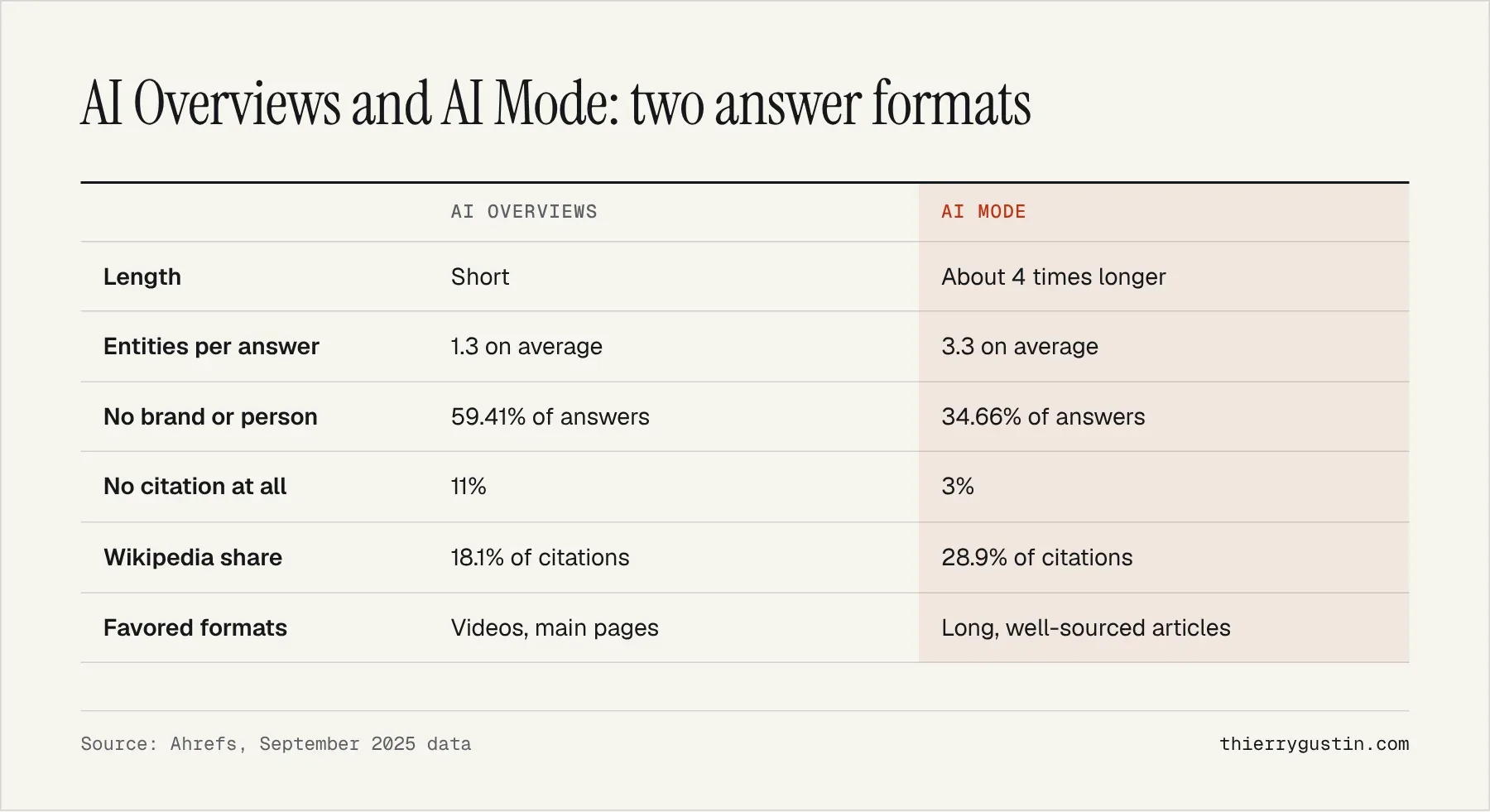
Other gaps matter for a small business. Quora is cited 3.5 times more in AI Mode, health sites and Facebook about twice as much, while Reddit is cited equally in both[1]. In the “cloud storage alternatives” example, the AI Overview cites seven brands once each, while AI Mode counts 23 brand mentions. AI Mode is therefore more open, but also more crowded: you share the answer with more competitors.
Gemini 3, Gemini 4: why the gap is not closing
Right now, this figure is often presented alongside the switch of AI Overviews to Gemini 3. Here too, the date needs correcting: it was on January 27, 2026 that Robby Stein, VP of Product for Google Search, announced Gemini 3 as the default model for AI Overviews worldwide, along with the ability to ask a follow-up question from an AI Overview and jump into AI Mode while keeping the context[2].
Since then, AI Mode has taken a different path. Gemini 4 Argon has been rolling out there since October 13, 2026 for Google AI Pro and Ultra subscribers[3]. On November 16, Search Engine Roundtable reported that Gemini 4 Carbon, initially reserved for Ultra subscribers, was reaching Pro subscribers, and that the model name had disappeared from the AI Mode header[4]. Rajan Patel, VP of Engineering for Google Search, confirmed: “Intended, but we’re thinking through the right way to bring back an indicator for your selected model.”
Finally, Google is hesitating over the boundary between the two. On November 13, Glenn Gabe spotted a test in which the AI Mode tab disappears from the search bar and the “Ask anything” box is missing below an AI Overview; Google has confirmed nothing[5]. For Chris Long, quoted by Search Engine Roundtable, this is because AI Mode “is no longer a separate experience.”
My take
My analysis: the 13.7% figure is a year old, and I would not present it as a current measurement. But nothing that has happened since suggests the gap has narrowed. The two surfaces no longer run on the same models for all users, do not produce answers of the same length and do not favor the same formats. That is a hypothesis, not a measurement, but it is the one I work with.
The practical consequence is simple: a report that adds up “Google AI visibility” without distinguishing the two surfaces mixes two realities. A client can be very present in AI Overviews thanks to their videos and absent from AI Mode for lack of in-depth content, or the other way around. I developed this point for AI Mode in France in my article on the arrival of AI Mode in July.
Hiding the model name bothers me more. It becomes harder to know why a citation appears or disappears. I now note, for each check, the type of account used, because a Pro subscriber and a free user do not necessarily see the same answer.
How do you measure the two surfaces separately?
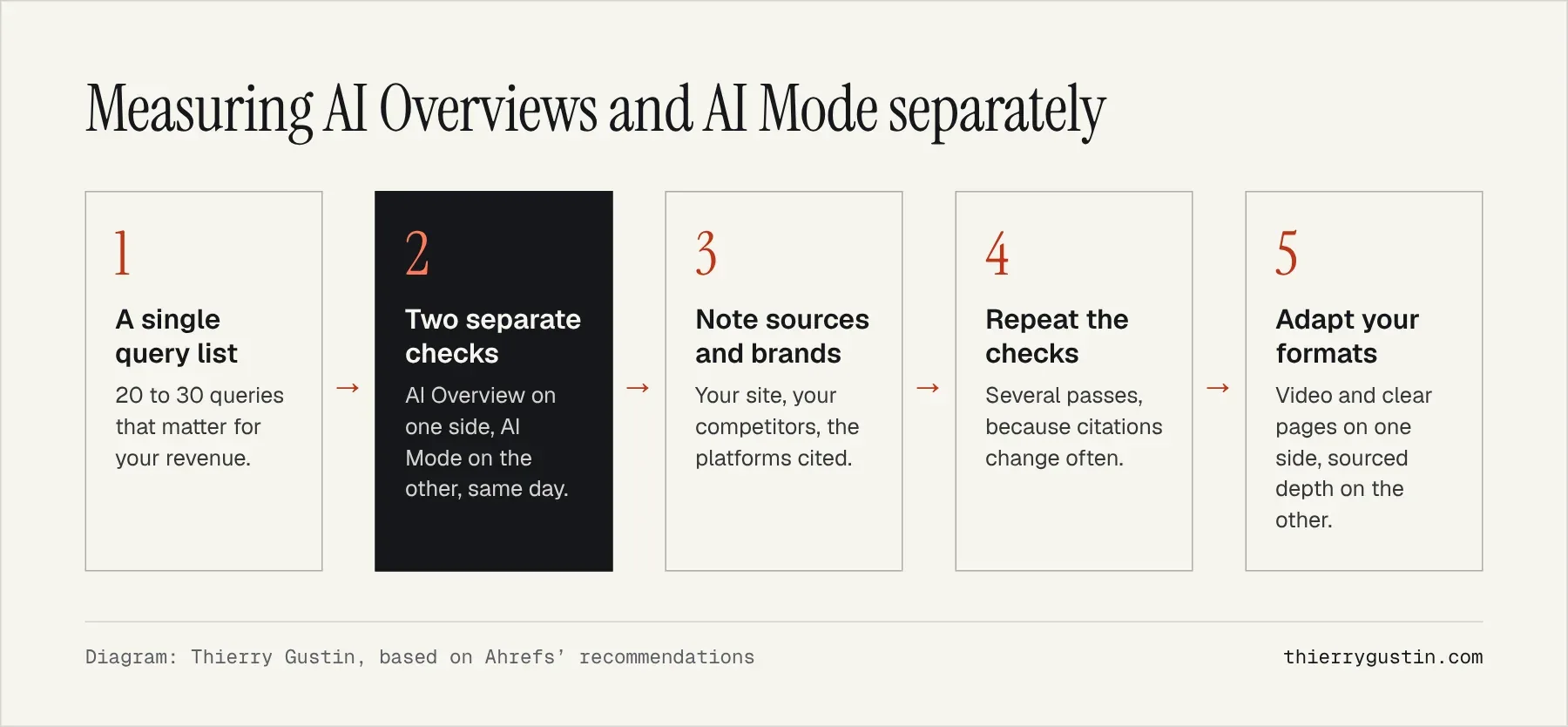
- Separate your dashboards: two columns, two citation rates, never an average.
- For AI Overviews, polish short answers at the top of the page and your YouTube videos, the most cited domain according to Ahrefs.
- For AI Mode, bet on in-depth, well-sourced content that covers a whole topic, and on your presence in encyclopedic and community sources.
- Check your brand listings: on some branded searches, the AI Overview now takes the place of the knowledge panel, as I explain in this article.
- Date and label every check: free or subscriber account, country, device.
These checks take time by hand, especially when repeated. That is why I built Vigie, an open-source tool that tracks visibility in AI answers. Whatever the tool, the important thing is to keep the two surfaces in separate columns, as Ahrefs recommends[1].
Frequently asked questions
Do AI Mode and AI Overviews cite the same sources?
Rarely. According to Ahrefs, on US data from September 2025, only 13.7% of cited URLs are shared by the two surfaces for the same query, and 16.3% for the top three citations. Yet the answers are 86% similar in meaning. Google reaches the same conclusions with different sources, which means you need to track each surface separately.
Is the 13.7% figure recent?
No. It comes from an Ahrefs study published on December 15, 2025, based on September 2025 data, and it is circulating again in November 2026 without its date. Since then, the two surfaces have used different models depending on the user, with Gemini 3 by default in AI Overviews and Gemini 4 in AI Mode for subscribers. A new measurement would be useful.
Which model do AI Overviews use in November 2026?
Google made Gemini 3 the default model for AI Overviews worldwide on January 27, 2026. AI Mode has evolved separately: Gemini 4 Argon since October 13, 2026 for Pro and Ultra subscribers, then Gemini 4 Carbon opened to Pro subscribers on November 16. The model name no longer appears in the AI Mode header.
What content should you prioritize to get cited in AI Mode?
According to Ahrefs, AI Mode favors long answers with more brands and sources, and cites Wikipedia, Quora and health sites more often. In-depth, well-sourced and comprehensive content on a topic therefore has a better chance of being picked up. AI Overviews, by contrast, cite more videos and main pages.
Sources
- Ahrefs, Despina Gavoyannis, “Are AI Mode and AI Overviews Just Different Versions of the Same Answer? (730K Responses Studied)” (December 15, 2025)
- PPC Land, Gemini 3 by default in AI Overviews and follow-ups into AI Mode (January 28, 2026)
- Search Engine Roundtable, Gemini 4 Argon in AI Mode (October 13, 2026)
- Search Engine Roundtable, AI Mode drops the Gemini label and opens Gemini 4 Carbon to Pro subscribers (November 16, 2026)
- Search Engine Roundtable, Google tests removing the AI Mode tab and the “Ask anything” box (November 13, 2026)