When an AI Overview Replaces the Knowledge Panel: Protecting Your Brand Entity
 By Thierry Gustin
Updated
7 min read

Contents
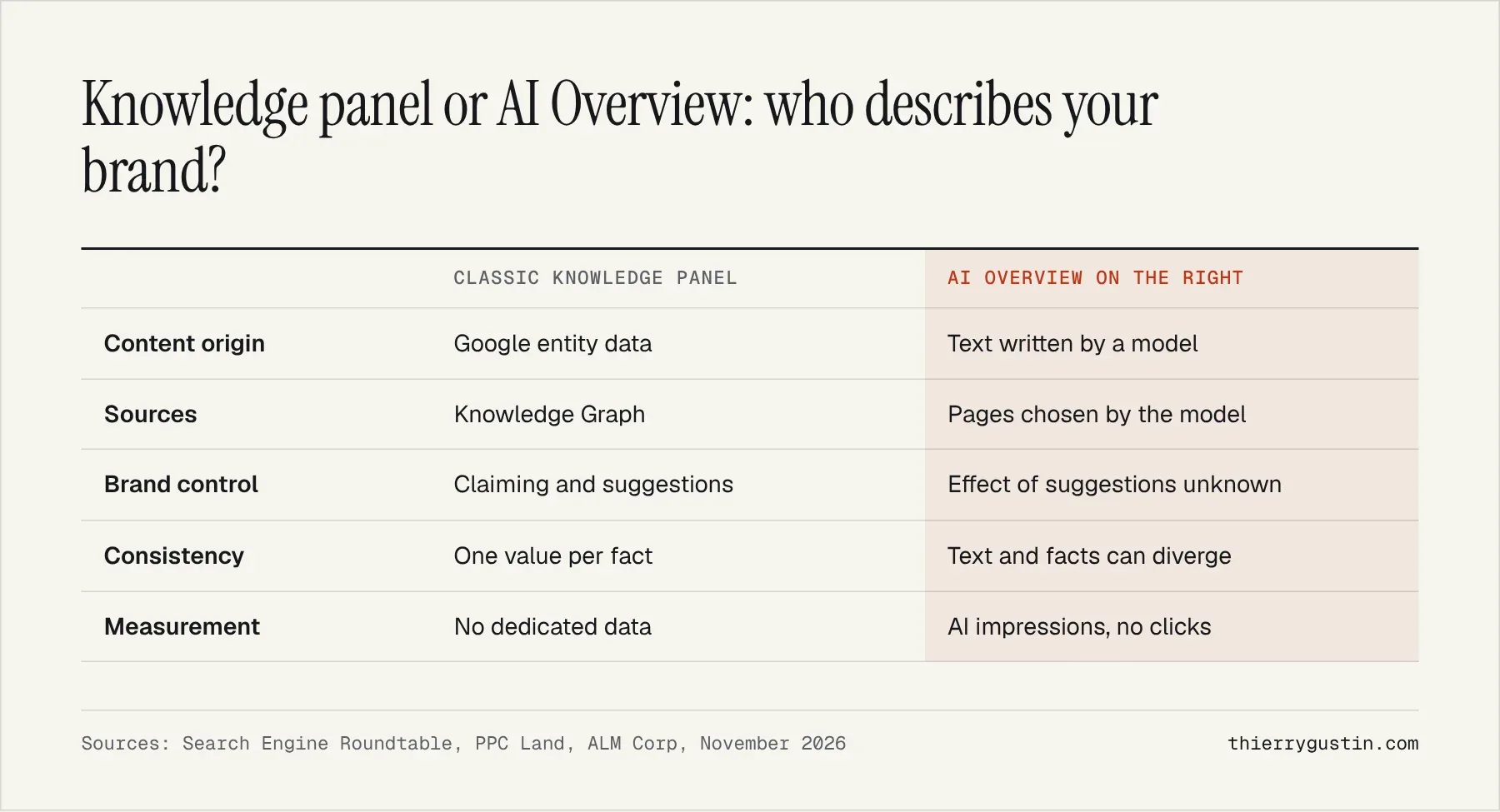
On some branded searches, Google has replaced the knowledge panel in the right-hand column with an AI Overview: an AI-written text that the brand cannot edit directly now sits where its identity card used to be[1][2]. The change, spotted between October 31 and November 2, 2026 on desktop in the United States, was not announced by Google. To protect your brand entity, you have to work on what the AI reads: your own site, your structured data and the third-party sources that talk about you.
For a small business, a search for its own name is often the most valuable one: it comes from customers who already know you, from referred prospects, from job candidates. If the answer shown next to your site contains a wrong date or a poorly described activity, your first impression takes the hit. And unlike the knowledge panel, you have no known lever to correct that text.
What has changed on branded searches?
On November 2, 2026, Barry Schwartz showed on Search Engine Roundtable that Google was moving AI Overviews for many branded queries from the top or middle of the results to the right-hand column, on desktop[1]. His examples: Apple, Zillow, Coca-Cola, Google and Search Engine Roundtable itself. Chris Long summed it up on X: Google swapped the knowledge panel for an AI Overview in the right-hand column. David McSweeney had spotted the layout as early as October 31, and noted that some AI Overviews also appeared lower down the page.
The brand’s own site, meanwhile, moves up to the top of the main column, with its sitelinks[2]. On the right, the block labeled “AI Overview” mixes written text and fact lines: for Apple, a 4.6 rating from 12,000 reviews, free returns within 14 days, the founders. According to PPC Land, all the published examples concern US results, and Google has said neither whether it is a test nor whether other markets will follow.
There was an early warning sign: on October 27, Sachin Patel pointed out on X that the knowledge panel now carried an “AI-generated” label[1]. Barry Schwartz considers the right-hand column a better fit than the top of the page, but doubts the AI describes a brand as well as its own site does.
Why is this a problem for your brand entity?
The knowledge panel relied on entity data the brand could influence, by claiming its panel and suggesting edits[3]. The AI Overview is produced by a model that picks its own sources. PPC Land stresses that the brand cannot edit this text, and Google has not said whether the “Suggest edits” link, still visible on Search Engine Roundtable’s panel, has any effect on the written part[2].
The Zillow example shows the risk. The AI text says the company was founded in 2006, while the fact line just below says 2004[2]. PPC Land points out that both dates make sense (founded in 2004, launched online in 2006), but the panel does not explain this. For a small business less well known than Zillow, this kind of inconsistency could just as easily come from an outdated directory listing or an old press article.
Which sources does the AI use to describe a brand?
That is the key question, and Ahrefs offered a first answer on October 2, 2026[4]. In a panel of 100 major brands, 63 queries showed an AI Overview on September 30, compared with 5 out of 98 usable results on July 1. In 48 of the 63 cases, the AI Overview held the top position. And among the 57 AI Overviews whose source list was available, Wikipedia was cited 41 times.
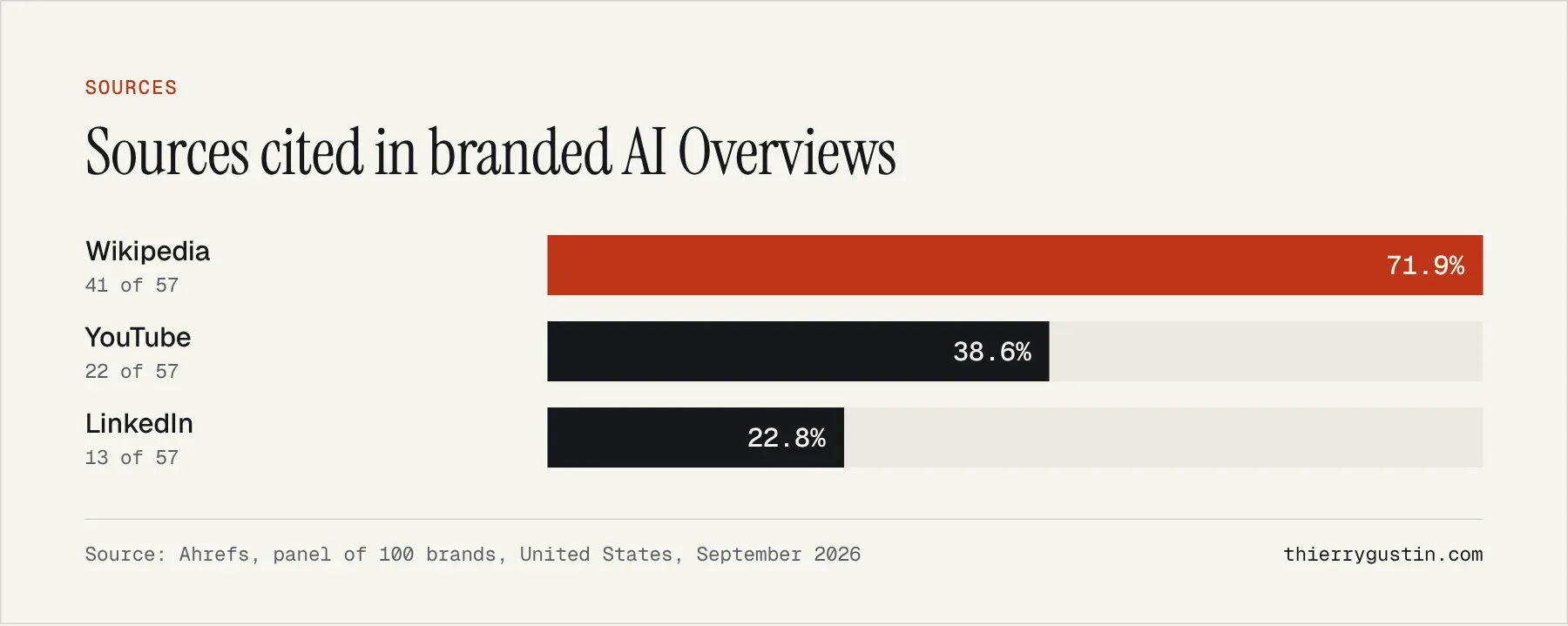
These are large US brands, and a small business often has no Wikipedia page. But the principle carries over: the AI describes a company based on third-party pages it considers reliable, not just its own site. Ahrefs also warns that cited videos may contain outdated product information[4].
My take
My analysis: this is a change of ownership of the identity card. For years, the knowledge panel was a space you could, with a bit of method, claim and correct. The AI Overview turns it into a summary of what the web says about you. The brand does not lose all control, but that control becomes indirect: it runs through the quality and consistency of every source.
I do not want to overstate the scope of the change. No observer has published a count of the queries affected, all the examples are from the US, and Google may roll it back. But the underlying trend is measured: AI Overviews have been settling into branded searches since the summer, as I had already noted in my article on preferred sources and brand SEO. Where they sit on the page, however, is up to Google.
The right reflex is therefore the same as for all GEO work: do not look for a trick on Google, make your company’s identity impossible to summarize wrongly. One name, one activity, one address, and the same dates and figures everywhere.
How do you protect your brand entity?
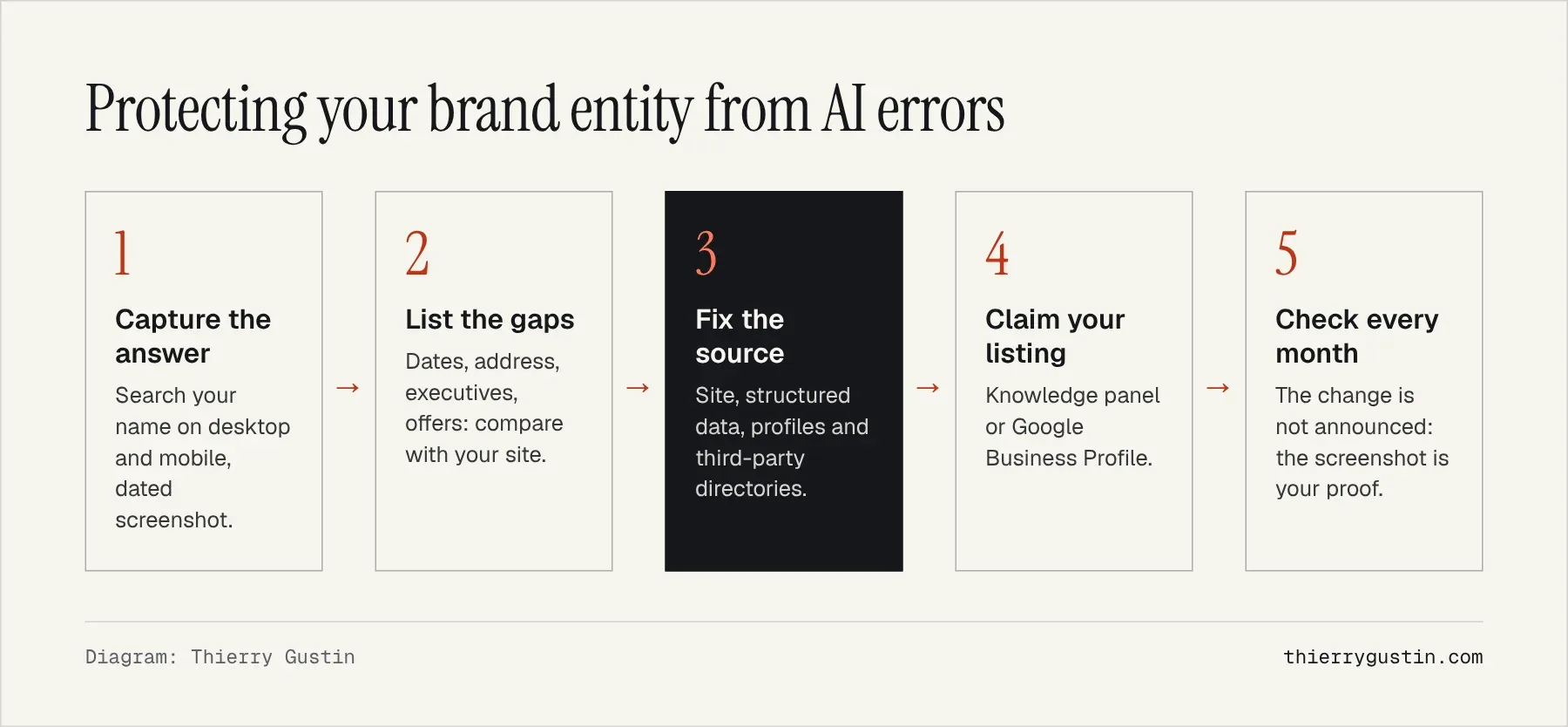
1. Your site as the reference source. A factual “about” page: legal name, founding date, executives, address, a one-sentence description of what you do, verifiable figures. This is the page the AI must be able to cite without ambiguity.
2. Organization structured data. Google says it helps it understand an organization’s administrative details and distinguish it from others in the results[5]. No property is required, but Google recommends in particular name, url, logo, sameAs (pages on other sites that talk about you), address and contact details. The markup goes on the home page or on a page describing the organization, not on every page. The basics are covered in my guide, in the structured data section.
3. Third-party sources. LinkedIn company page, YouTube channel, business directories, local press, Business Profile: check that they say the same thing as your site. An old address or a former name in a directory is enough to create a contradiction.
4. Claiming. If a knowledge panel still exists for your brand, claim it: Google offers a “Claim this knowledge panel” button and verification through an official site or profile; suggestions sent from the verified account are handled as a priority[6]. For a business that serves customers in person, Google points to the Business Profile instead.
5. Monitoring. As ALM Corp recommends, a dated screenshot every month, with the claims noted and the sources listed, remains the only reliable record[3]. According to PPC Land, the AI report in Search Console gives impressions, but neither clicks nor queries[2].
Frequently asked questions
Has Google removed the knowledge panel for brands?
Not everywhere. Since late October 2026, on some branded searches, Google has shown an AI Overview in the right-hand column instead of the knowledge panel, on desktop. The published examples are from the US and Google has made no announcement. The change may be a test and, so far, does not affect every brand or every country.
Can you edit the AI Overview text about your brand?
Not directly. The text is written by a model from the sources it chooses. The “Suggest edits” link remains visible on some panels, but Google has not said whether it affects the written part. The real lever is to fix the sources: your site, your structured data and the third-party pages that talk about you.
Is Organization structured data enough?
No, but it helps. Google says this markup helps it understand an organization’s administrative details and distinguish it from others. It guarantees no particular display. It needs to go hand in hand with a factual “about” page and consistent third-party profiles, because the AI cross-checks several sources to describe a brand.
Is a small business without a Wikipedia page at a disadvantage?
It starts with one source fewer, since Wikipedia is the most cited source in the major-brand AI Overviews studied by Ahrefs. Creating a promotional page is not the answer. It is better to look after the sources within reach: LinkedIn profile, up-to-date YouTube videos, business directories, local press and Google Business Profile.
Sources
- Search Engine Roundtable, Barry Schwartz, “Google AI Overviews For Brands Moved To Right Column” (November 2, 2026)
- PPC Land, Google moves AI Overviews for brand searches out of the main results (November 3, 2026)
- ALM Corp, Emilio Fuentes, Google replaces brand knowledge panels with AI Overviews (November 9, 2026)
- Ahrefs, Ryan Law, AI Overviews on branded searches (October 2, 2026)
- Google Search Central, Organization structured data
- Google Help, claim a knowledge panel
Read next
AI Mode and AI Overviews Don’t Cite the Same Sources: Measure Them Separately
AI Mode vs AI Overviews: only 13.7% of cited URLs in common, per Ahrefs. What the study says, what has changed since, and how to measure both.