AI Overviews on 80% of Google Searches: What Changes and What to Measure
 By Thierry Gustin
Updated
7 min read

Contents
“AI Overviews 80%” is the figure that opens the monthly recap Search Engine Roundtable published on November 2, 2026. Google’s AI Overviews now appear on more than 80% of searches, according to a roundup of several tracking tools[1][2]. For a business, the question is no longer whether its queries are exposed, but whether its site is cited in those answers, and how to measure that while Google still publishes no click data.
The same recap lines up two other facts pointing the same way: a new model, Gemini 4 Argon, now writes some AI Mode answers, and Google has once again reworked the links in these blocks without providing any click data[1]. In France, where AI Overviews and AI Mode arrived on July 22, the first studies with traffic figures are summarized in my article on the impact of AI Overviews on traffic. Here, I focus on what the 80% threshold changes in how you run a site.
Where does the 80% figure come from?
The figure comes from an October 26, 2026 article by Barry Schwartz titled “Over 80% Of Google Searches Have AI Overviews & Growing”[2]. It draws on recent data from Semrush, SE Ranking and seoClarity, without stating which of these tools produces the 80% exactly, nor the country or device. So read it as an order of magnitude, not an official statistic: Google itself does not disclose this rate.
The detailed measurements in the same article give a range[2]. SE Ranking sees AI Overviews on 82.5% of branded searches in the United States. At seoClarity, Mark Traphagen reported about a month earlier more than 62% of queries, ranging from 55% to 84% depending on the industry. Barry Schwartz recalls the trajectory: around 15%, then 50% in June 2025, and more than 80% today.
Ahrefs, for its part, measured an average of 73.3% of branded searches with an AI Overview in September 2026, and 82.91% on September 29, on desktop in the United States[7]. The methods differ (keyword panel, query type, date), but every curve is heading in the same direction.
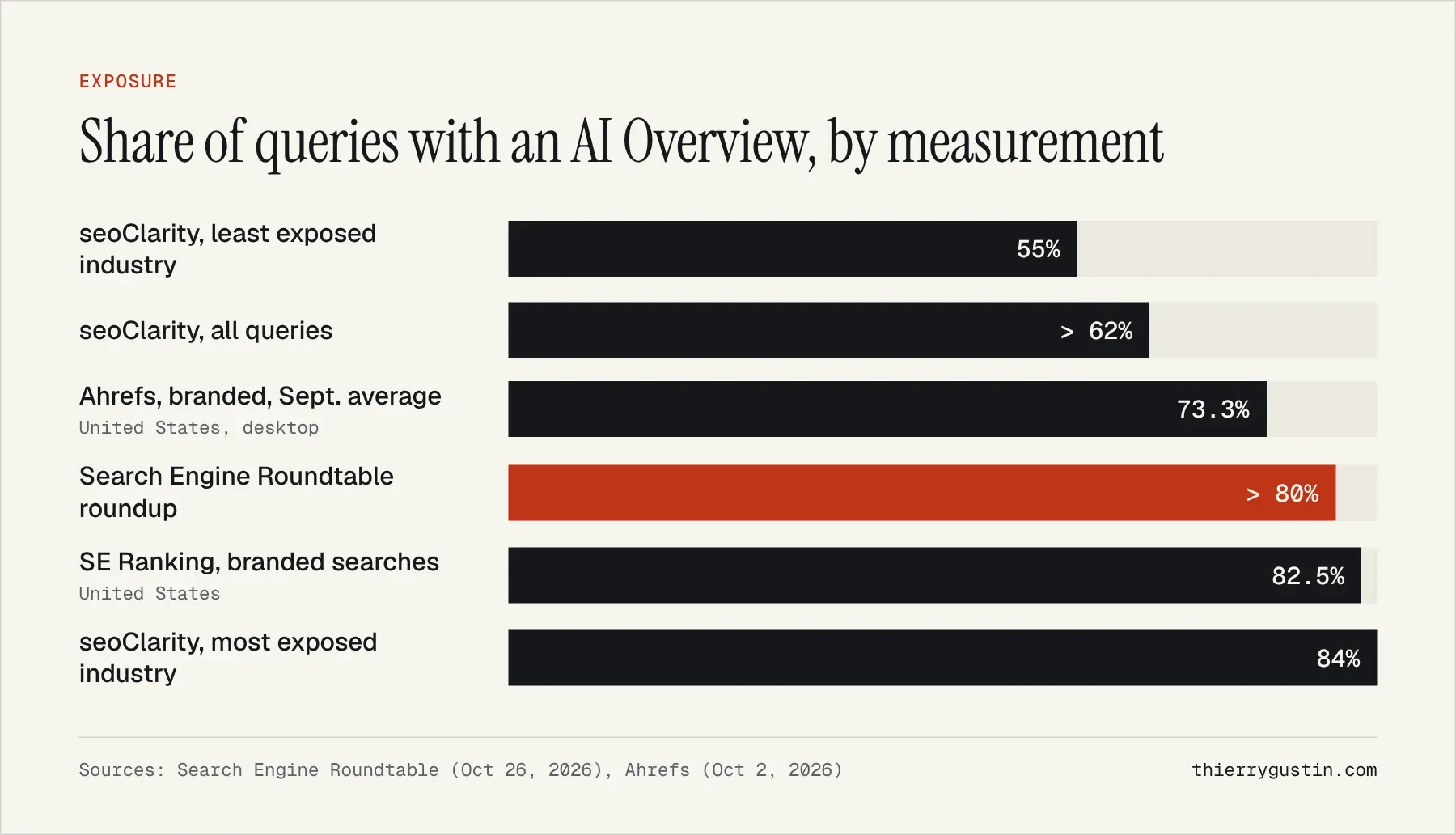
A word of caution for my clients in France and Spain: these measurements mostly cover US results. The real rate in your market and on your queries may be lower or higher. The only way to know is to check your key queries yourself, as I explain below.
Which model answers in Google’s AI Mode?
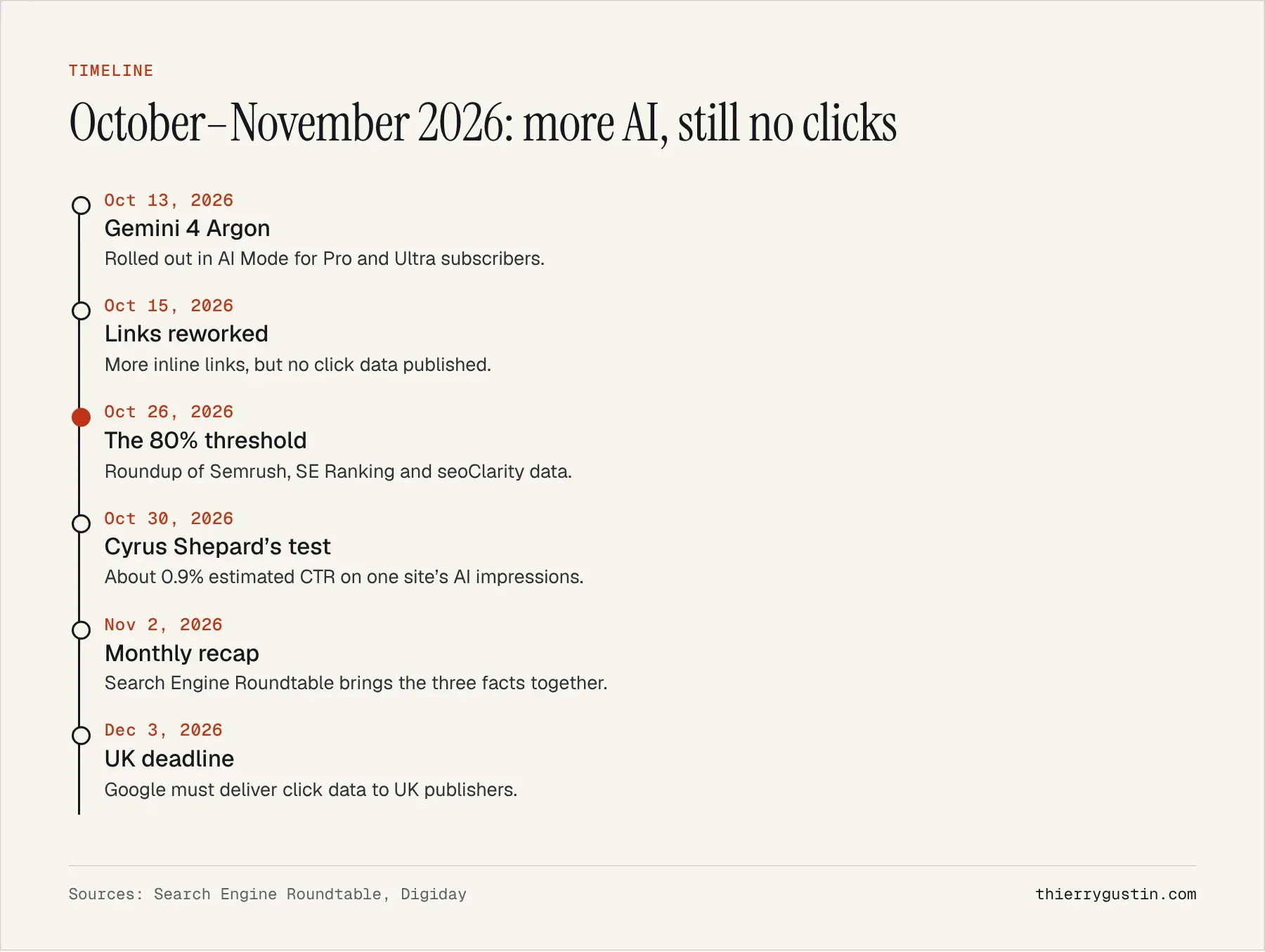
Since October 13, 2026, Gemini 4 Argon has been rolling out in Google Search’s AI Mode worldwide for Google AI Pro and Ultra subscribers[3]. Nick Fox and Robby Stein at Google announced it on X: “Gemini 4 Argon is now rolling out globally in Search!” Google presents it as better at complex, multi-step tasks and at following instructions over the course of a conversation.
A useful detail for publishers: according to an observation by Gagan Ghotra cited by Search Engine Roundtable, Argon’s answers in AI Mode contain links, unlike the previous version running on Gemini 3.8 Flash[3]. The model writing the answer is therefore not a technical footnote: it affects the length of the answer, the number of sources and whether links appear. And it can change from one month to the next without your site changing at all.
Google is adding links: but how many clicks?
On October 15, 2026, Google announced more inline links in AI Mode and AI Overviews answers, links placed higher up, and news carousels that highlight preferred sources[4]. I covered these changes in my article on AI Mode links and preferred sources. What matters here is what Google did not provide.
Barry Schwartz asked for click data in the AI reports of Search Console. Google’s reply: “We’re continuing to work with website owners to understand what insights will be most helpful,” with a promise to add “additional metrics over time”[4]. In other words, we know there are more links, but we do not know whether they get clicked.
The only recent figure is an estimate to be taken with a grain of salt. On October 30, Cyrus Shepard published a small test on a single site: he opted it out of AI Overviews and AI Mode using the Search Console setting, then compared before, during and after[5]. By subtraction, he estimates the click-through rate of AI impressions at about 0.9%, with AI impressions making up about 8% of the total. More surprising to him: during the opt-out, classic organic clicks also fell. Search Engine Roundtable itself calls the study “super limited.”
The timeline to watch is British. Digiday noted on November 9 that Google must provide click data to UK publishers by December 3, under obligations imposed by the UK competition authority, without having confirmed it will share that data elsewhere[6]. Page-level opt-out controls are expected by March 3, 2027. Until these figures exist, deciding to turn off AI Overviews remains a gamble.
My take
My analysis: at more than 80%, the AI Overview is no longer a feature, it is the results page itself. Asking “am I affected?” no longer makes much sense. The right questions are: which queries am I cited on, who is cited instead of me, and do the visits I still get convert?
I remain cautious on two points. First, the figure is a US roundup, and I see clear differences among my clients depending on the industry and the type of query, which seoClarity’s range confirms. Second, Cyrus Shepard’s test covers a single site: it does not prove that opting out lowers organic traffic, it only suggests not deciding blindly.
What strikes me most is the asymmetry: Google keeps adding surfaces, models and links, but keeps the click to itself, the only metric that lets a small business calculate a return on investment. In the meantime, you have to build your own instruments, even simple ones.
What should you actually measure on your site?
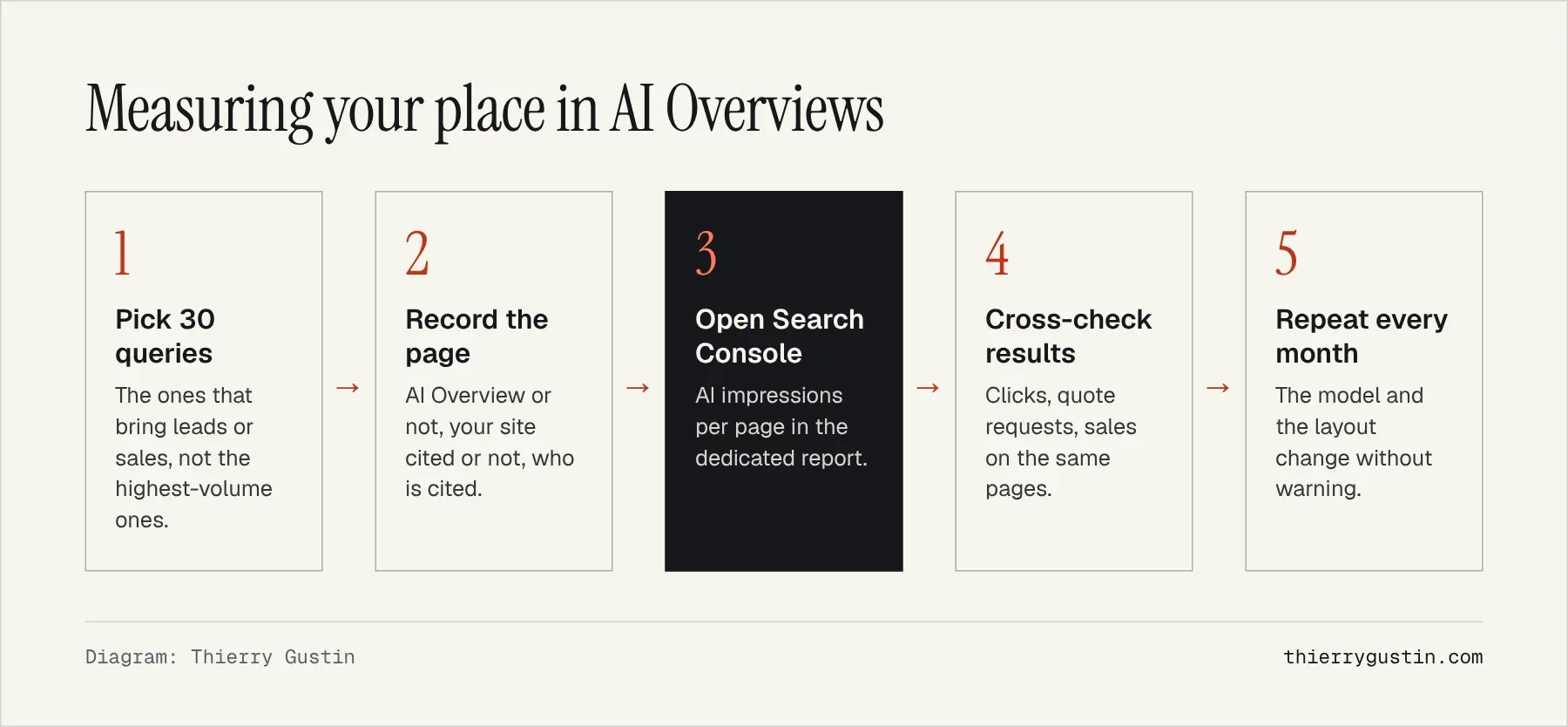
Here is the method I have been using with my clients since AI Overviews arrived in France. It takes half a day the first time, then one hour a month.
| Metric | Where to find it | Why |
|---|---|---|
| AI Overview present | Manual check or tracking tool | Measure your real exposure, not the US average |
| Your site cited | Manual check or tracking tool | Being cited is the only way to stay visible in the answer |
| AI impressions | Search Console generative AI report | The only data Google provides, with no clicks |
| Clicks and conversions | Search Console and analytics tool | Judge the real value of the remaining traffic |
| Competitors cited | Manual check or tracking tool | Know who is taking your place, and on which topics |
Two practical tips. Note the date and account type of each check, because a Pro or Ultra subscriber may see an answer written by a different model. And make no opt-out decision before you have at least two months of checks and, ideally, the first click data promised to UK publishers.
Frequently asked questions
Do AI Overviews really appear on 80% of Google searches?
That is the order of magnitude Search Engine Roundtable gave on October 26, 2026, based on data from Semrush, SE Ranking and seoClarity, without specifying the country or device. Detailed measurements range from 55% to 84% depending on the industry at seoClarity. Google does not publish this rate. For your site, only a check of your own queries gives a reliable figure.
Does Google report clicks from AI Overviews?
No. The Search Console generative AI report gives impressions, not clicks. Asked in October 2026, Google replied that it was working with site owners to understand which data would be useful. In the UK, it must provide click data to publishers by December 3, 2026, with no announced commitment for other countries.
Which AI model writes AI Mode answers?
It depends on the user. Since October 13, 2026, Gemini 4 Argon has been rolling out in AI Mode for Google AI Pro and Ultra subscribers worldwide. Its answers contain links, unlike a previous version running on Gemini 3.8 Flash. The model can therefore change the answer, and your citations, without any change to your site.
Should you turn off AI Overviews to win back clicks?
Nothing proves it today. The only published test, Cyrus Shepard’s on one site, shows that organic clicks also fell during the opt-out, but the sample is too small to draw conclusions. Opting out removes your site from the answers without making the AI Overview disappear. I recommend waiting for click data before deciding.
Sources
- Search Engine Roundtable, Barry Schwartz, November 2026 monthly recap (November 2, 2026)
- Search Engine Roundtable, “Over 80% Of Google Searches Have AI Overviews & Growing” (October 26, 2026)
- Search Engine Roundtable, Gemini 4 Argon in AI Mode (October 13, 2026)
- Search Engine Roundtable, new links in AI Mode and AI Overviews, with no click data (October 15, 2026)
- Search Engine Roundtable, Cyrus Shepard’s opt-out test and estimated click-through rate (October 30, 2026)
- Digiday, Jessica Davies and Seb Joseph, publishers await click data (November 9, 2026)
- Ahrefs, Ryan Law, AI Overviews on branded searches (October 2, 2026)
Read next

AI Mode and AI Overviews Don’t Cite the Same Sources: Measure Them Separately
AI Mode vs AI Overviews: only 13.7% of cited URLs in common, per Ahrefs. What the study says, what has changed since, and how to measure both.